Quick answer
The Atalante X is Wandercraft's self-balancing, active lower-limb exoskeleton for overground gait rehabilitation, rated to 100 kg user weight, 145–190 cm height, 2.5 km/h speed, 12 degrees of freedom and 80 kg lift support, with CE medical marking under IEC 60601-1 and ISO 13482. It is a capital-purchase, therapist-supervised clinical device sold in Europe and North America, and the maker does not publish an indicative price, peak assist force or peak assist torque. Buyers should treat it as a high-throughput overground training platform, not a portable or stair-capable system.
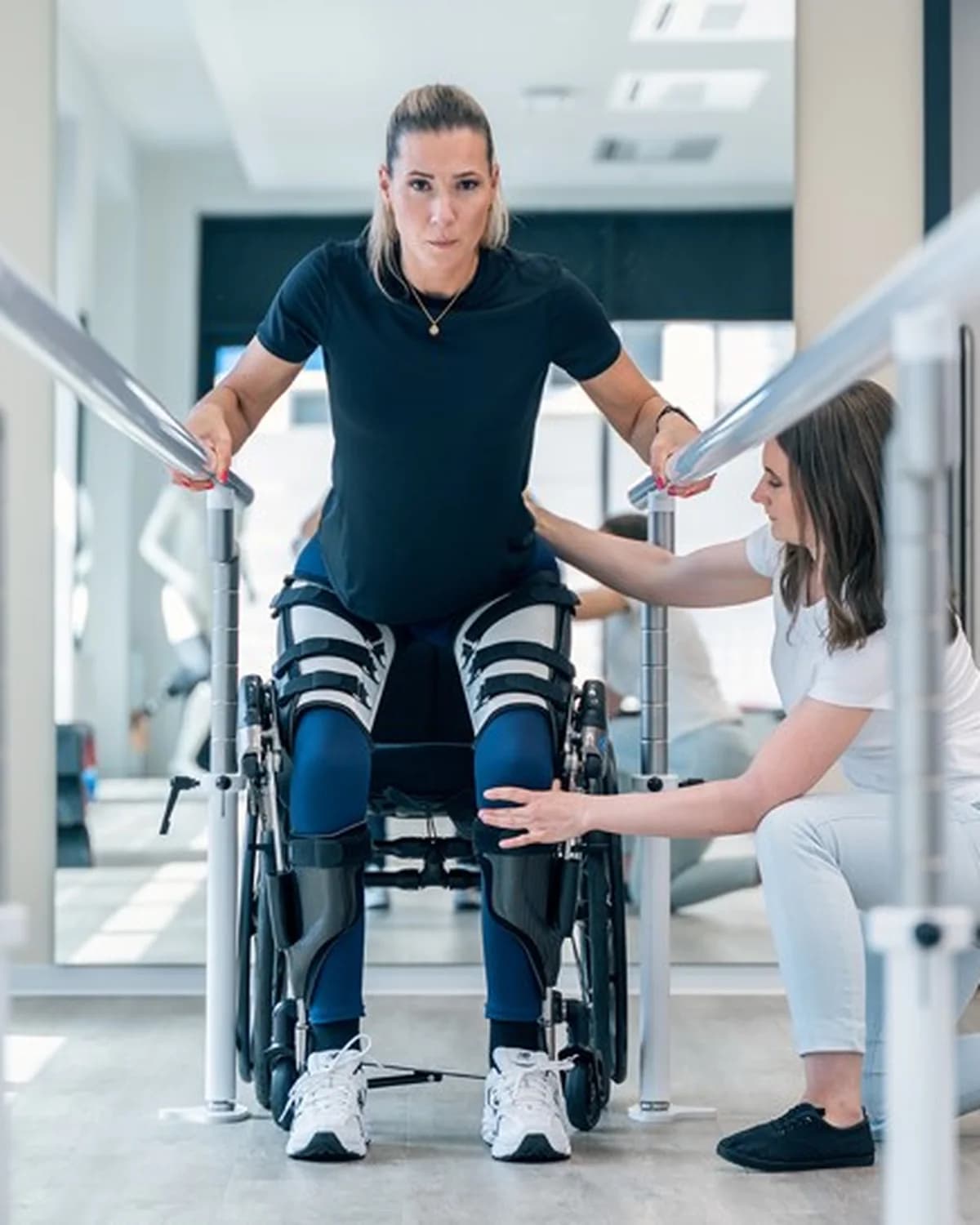
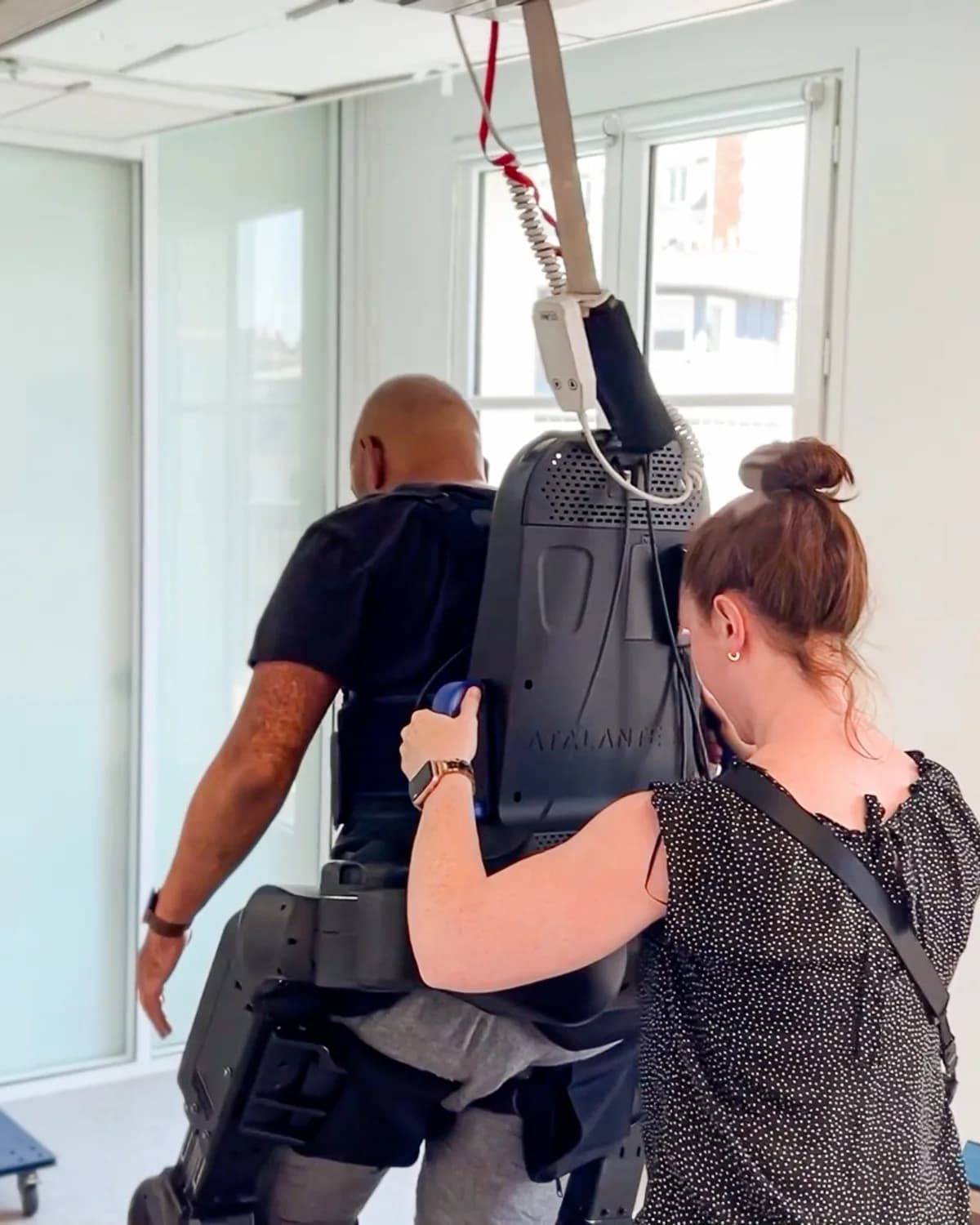
Atalante X is the only system in this dataset that carries 12 degrees of freedom and a documented 80 kg lift support figure, which is why it appears on shortlists for overground gait training in neurological rehabilitation. The 65 kg system weight, 2.5 km/h top speed and self-balancing control mode separate it sharply from the 4-DOF therapist-supervised devices it is usually compared against. This spotlight covers the documented specifications, the parameters Wandercraft does not disclose, and the deployment conditions that decide whether Atalante X fits a rehabilitation unit.
Key takeaways
- Atalante X is a 65 kg active exoskeleton with 12 DOF, 2.5 km/h speed and 80 kg lift support — the heaviest and most kinematically complex system in the supplied dataset.
- Rated for users up to 100 kg and 145–190 cm; frame is an adjustable adult size in aluminium and carbon fibre.
- Self-balancing walk and therapist-guided movement are the two documented control modes; stairs are not supported.
- CE medical, IEC 60601-1 and ISO 13482 are listed; FDA status is not stated in the data.
- Price, peak assist force and peak assist torque are undisclosed or unknown — three gaps that block a like-for-like tender comparison.
Documented specifications
The table below uses only figures recorded in the ExoSelect database for Atalante X. Where a value is missing, it is marked as not disclosed rather than estimated.
| Parameter | Atalante X (Wandercraft) |
|---|
| Drive type | Active |
| System weight | 65 kg |
| User height range | 145–190 cm |
| Max user weight | 100 kg |
| Degrees of freedom | 12 |
| Speed | 2.5 km/h |
| Lift support | 80 kg |
| Terrain | Level ground and slopes; stairs not supported |
| Control modes | Self-balancing walk, therapist-guided movement |
| Sensors | Force plates, joint encoders, IMU |
| Battery | Lithium-ion, 4 h life, 3 h charge, swappable |
| Connectivity | Clinical dashboard |
| Certifications | CE medical |
| Standards | IEC 60601-1, ISO 13482 |
| Warranty | 12 months |
| Regions | Europe, North America |
| Peak assist force | Not disclosed |
| Peak assist torque | Unknown |
| Indicative price | Not disclosed |
How Atalante X compares on the supplied numbers
The clearest differentiator is kinematic complexity. Atalante X lists 12 DOF against 4 for EksoNR, ExoMotus M4 and Indego, and 2 for HAL Lower Limb. More joints means more actuated segments and more calibration surface, which is a maintenance and training consideration as much as a clinical one.
Speed also diverges. Atalante X is rated to 2.5 km/h, above Indego at 2 km/h, HAL Lower Limb at 1.5 km/h, ExoMotus M4 at 1.2 km/h and EksoNR at 1.1 km/h. For overground training where gait velocity is a therapy variable, that headroom matters. It comes at a cost: at 65 kg, Atalante X is roughly 2.8 times the weight of EksoNR (23.6 kg) and more than five times Indego (12.3 kg). Moving it between treatment rooms is a two-person task in practice, and floor loading should be checked before installation.
Atalante X is also the only system here with a published lift support figure (80 kg). EksoNR, HAL Lower Limb, ExoMotus M4 and Indego all record lift support as not applicable in the database. Buyers comparing sit-to-stand assistance should note that this is a documented Atalante X capability, not a shared category feature.
What the datasheet doesn't tell you
Peak assist force (undisclosed). Without a force figure, a procurement team cannot match the device to a patient cohort's required assistance level, and cannot benchmark it against EksoNR or HAL Lower Limb, which both list 40 Nm peak assist torque. Atalante X's torque is recorded as unknown, so the two systems cannot be compared on actuation output at all from public data.
Indicative price (undisclosed). Wandercraft quotes a capital purchase and service programme directly. That means the total cost of ownership — service contract, therapist training, spare parts, battery replacement — is negotiated rather than published, and budget holders cannot pre-qualify the device against a fixed capital envelope. See our analysis of medical exoskeletons for how this pattern affects lifecycle budgeting.
FDA status. The database lists CE medical only. For North American buyers, the regulatory pathway is not stated, and this should be confirmed in writing before any clinical deployment in the United States.
Lead time. Recorded as "contact maker." EksoNR publishes 8–12 weeks; Atalante X does not, which complicates installation planning for a new gait lab.
Who should not choose this
Do not choose Atalante X if your unit needs a device that one therapist can move and set up alone between sessions. At 65 kg with a 12-DOF frame, it is a fixed-station asset, and clinics that rotate equipment across rooms or floors will find it impractical compared with Indego at 12.3 kg or EksoNR at 23.6 kg.
Do not choose it if stair training is on your clinical protocol. The database states stairs are not supported; only level ground and slopes are covered. And do not choose it if your procurement process requires a published capital price or a documented peak assist force at tender stage — both are undisclosed, and a committee that scores bids on those fields will be unable to evaluate Atalante X fairly against EksoNR or HAL Lower Limb.
Conversely, a high-volume neurorehabilitation centre in Europe or North America with a dedicated treatment bay, a 100 kg-capable patient mix and a protocol built around overground speed progression is the profile this device is documented for.
Deployment and compliance notes
Atalante X is listed for Europe and North America only. Buyers in Asia-Pacific or the Middle East should confirm regional availability directly, since the database does not record it. The 12-month warranty matches every other system in the dataset, so it is not a differentiator. The clinical dashboard connectivity is the only data-export route documented; there is no mention of Bluetooth or third-party EMR integration, unlike Indego's Bluetooth and EksoNR's EksoPulse software.
Battery figures are competitive but not class-leading: 4 h life matches EksoNR and Indego, while the 3 h charge time is the slowest in the dataset (EksoNR 2.5 h, HAL 2 h, ExoMotus 2 h, Indego 2.5 h). Swappable batteries mitigate this, but a spare pack should be budgeted.
Procurement checklist before you commit
- Request the peak assist force and peak assist torque in writing from Wandercraft.
- Confirm FDA clearance status for any US deployment.
- Ask for a written lead time and installation floor-loading specification.
- Obtain a full service-programme quote covering training, spares and battery replacement.
- Verify the clinical evidence package — the database records "clinical studies in neurological rehabilitation" without naming trials.
Use the comparison tool to place Atalante X against EksoNR and Indego on the documented fields, and send a documented-parameter request through our selection desk if you need the undisclosed figures chased.
FAQ
What is the maximum user weight for Atalante X?
100 kg, per the ExoSelect database. The height range is 145–190 cm on an adjustable adult frame.
Does Atalante X support stair climbing?
No. The database states level ground and slopes are supported; stairs are not.
How much does Atalante X cost?
The price is not disclosed. Wandercraft quotes a capital purchase and service programme directly, so no indicative figure is available for budgeting.
Next step
Request the peak assist force and peak assist torque from Wandercraft in writing, then compare the returned figures against EksoNR's documented 40 Nm on our comparison page. If the maker will not release them, that silence is itself a procurement finding.
 ExoSelect research