Quick answer: The core procurement questions for industrial exoskeletons are: what assistive force and torque are documented, what certifications and standards apply, what is the total cost including consumables and service, and what operational limits (battery, weight, height range) will constrain deployment. This FAQ answers those questions using only published specifications for five industrial systems: Cray X, Skelex 360, MATE-XT, Apex 2 and AIRFRAME.
What should a procurement team ask first?
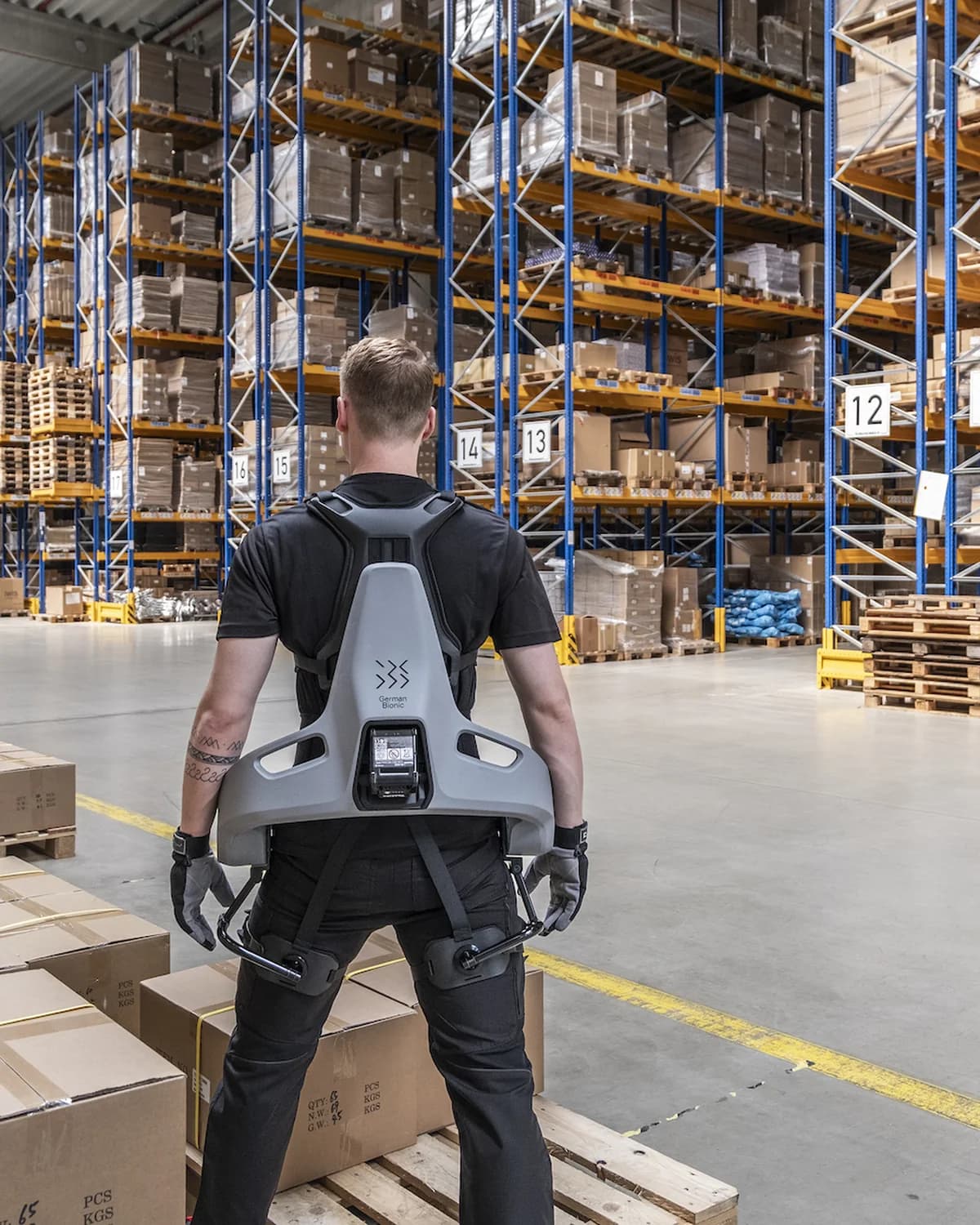
Start with the task and the physical envelope, not the technology label. Ask which movements the device is designed to support, what assistive force and torque the manufacturer documents, and whether the user population fits the stated height and weight ranges. For example, Cray X is an active back exoskeleton rated at 300 N assist force and 30 Nm assist torque, with a height range of 160–195 cm and a user weight limit of 110 kg. Skelex 360 is a passive shoulder exoskeleton rated at 70 N and 12 Nm, with the same 160–195 cm height range and 110 kg user limit. MATE-XT, also passive for upper limbs, is rated at 100 N and 15 Nm, covers 155–195 cm and supports users up to 100 kg. Apex 2 is a passive hip-assist exosuit rated at 220 N and 22 Nm, with a 150–200 cm height range and a 125 kg user limit. AIRFRAME is a passive shoulder exoskeleton rated at 60 N and 10 Nm, covering 157–198 cm and users up to 113 kg.
These numbers are not interchangeable. A 300 N back-assist device and a 70 N shoulder-assist device solve different problems, and comparing them on price alone is a category error. The first procurement question is therefore: what is the documented assist profile for the specific task, and does the vendor provide a task-based fit assessment?
Which certifications and standards should be on the datasheet?
For industrial exoskeletons in Europe, CE marking is the baseline. ISO 13482 (robots and robotic devices — safety requirements for personal care robots) is the standard most often cited for exoskeleton safety. Cray X lists CE and ISO 13482, and also references EN 614-1 (ergonomic design principles). Skelex 360 lists CE and ISO 13482. MATE-XT lists CE and ISO 13482. Apex 2 lists CE but the standards referenced are unknown in the database. AIRFRAME lists CE, but standards referenced are unknown. Buyers should ask for the declaration of conformity and the specific standard list, not just the CE mark.
Note that ISO 13482 is not a substitute for a machine risk assessment under the Machinery Directive or Regulation. Procurement should ask whether the vendor provides a risk assessment template and whether the device is classified as a machine or a personal care robot in the target jurisdiction.
What are the real cost drivers beyond the list price?
Indicative list prices in the database range from 1,195 USD for Apex 2 to 9,900 USD for Cray X. But list price is not total cost of ownership. For active systems like Cray X, battery packs are hot-swappable lithium-ion with 8 h life and 2 h charge time; a multi-shift operation needs spare batteries and charging infrastructure, which are not included in the list price. Cray X also includes connectivity (Cray Visor app, cloud fleet dashboard, Bluetooth), which implies data management and possibly subscription costs that are not disclosed.
For passive systems, the cost drivers are different: fitting and training time, replacement of elastic bands (Apex 2 uses elastic bands), and warranty terms. Skelex 360 has a 24-month warranty; Apex 2 has a 12-month warranty; Cray X, MATE-XT and AIRFRAME have warranty undisclosed or unknown in the database. A 24-month warranty versus a 12-month warranty is a material difference in cost of ownership that should be priced into the comparison. Lead times also vary: Cray X 6–10 weeks, MATE-XT 4–8 weeks, Apex 2 2–4 weeks; Skelex 360 and AIRFRAME say contact maker.
How do the five systems compare on documented specs?
| System | Drive | Assist force | Assist torque | Weight | Price from (USD) | Certifications | Warranty |
|---|
| Cray X (German Bionic) | Active | 300 N | 30 Nm | 7.6 kg | 9,900 | CE, ISO 13482 | Undisclosed |
| Skelex 360 (Skelex) | Passive | 70 N | 12 Nm | 1.6 kg | 4,900 | CE | 24 months |
| MATE-XT (Comau) | Passive | 100 N | 15 Nm | 4.2 kg | 5,900 | CE, ISO 13482 | Undisclosed |
| Apex 2 (HeroWear) | Passive | 220 N | 22 Nm | 1.2 kg | 1,195 | CE | 12 months |
| AIRFRAME (Levitate Technologies) | Passive | 60 N | 10 Nm | 1.5 kg | 2,950 | CE | Unknown |
All prices are indicative list prices from the database and are not quotes. Assist force and torque are manufacturer-documented values. Weight is the device weight as stated. The table deliberately omits runtime for passive devices (not applicable) and clinical evidence (not applicable for industrial use).
What the datasheet doesn't tell you
Three parameters are missing or unverified across this dataset and each matters to a buyer. First, warranty for Cray X is undisclosed and for AIRFRAME is unknown. For a 9,900 USD active device, an undisclosed warranty is a material gap: it affects maintenance budgeting and residual value. Second, standards referenced for Apex 2 and AIRFRAME are unknown. CE marking alone does not tell you which harmonised standards were applied, so you cannot assess conformity without asking for the declaration. Third, connectivity and data ownership for Cray X are not specified beyond the app and dashboard names; buyers should ask where telemetry is stored, who owns it, and what happens at contract end. None of these gaps can be filled from the datasheet; they require a vendor questionnaire.
Who should not choose this
If your task is sustained overhead work with tools under 5 kg, do not choose Cray X. It is a back exoskeleton with a 7.6 kg device weight and 300 N assist force designed for lifting and forward bending; it will not reduce shoulder load and adds mass. Choose a passive shoulder system such as Skelex 360, MATE-XT or AIRFRAME instead. Conversely, if your task is repetitive lifting from floor to waist, do not choose a shoulder exoskeleton; the assist torque is in the wrong plane. And if you need documented clinical evidence for a worker rehabilitation programme, none of these five industrial systems provides it in the database; clinical evidence is not applicable or unknown for all five. Procurement should not accept an industrial exoskeleton as a medical device substitute.
What is the one next step?
Request the declaration of conformity and the warranty terms in writing for the two systems that pass your task-fit screen. Use the ExoSelect compare tool to put Cray X and Apex 2 side by side on documented specs, then send the vendor questionnaire to the maker. If you need help framing the questions, contact the ExoSelect selection desk.
FAQ
Do I need an active or passive exoskeleton for lifting?
Active systems like Cray X provide powered assistance (300 N, 30 Nm) and are suited to frequent lifting and forward bending. Passive systems like Apex 2 provide elastic assistance (220 N, 22 Nm) at lower cost and weight. The choice depends on task frequency, load and whether battery management is feasible.
Is CE marking enough for procurement?
No. CE marking indicates conformity but does not list the standards applied. Ask for the declaration of conformity and the specific standard references, such as ISO 13482, which is listed for Cray X, Skelex 360 and MATE-XT but unknown for Apex 2 and AIRFRAME.
What is the warranty on these exoskeletons?
Skelex 360 has a 24-month warranty and Apex 2 has 12 months. Cray X and MATE-XT warranties are undisclosed in the database, and AIRFRAME is unknown. Buyers should obtain warranty terms in writing before purchase.
Key takeaways
- Match assist force and torque to the task: back vs shoulder vs hip.
- Check height and user weight limits against your workforce.
- CE marking is not a substitute for a standards list; ask for the declaration.
- Warranty is a cost-of-ownership variable: 24 months vs 12 months vs undisclosed.
- Active systems add battery and data management costs not in the list price.
Sources: manufacturer product pages for Cray X, Skelex 360, MATE-XT, Apex 2 and AIRFRAME; ISO 13482 standard abstract. All specifications are as published in the ExoSelect database and are subject to vendor confirmation.
 ExoSelect research