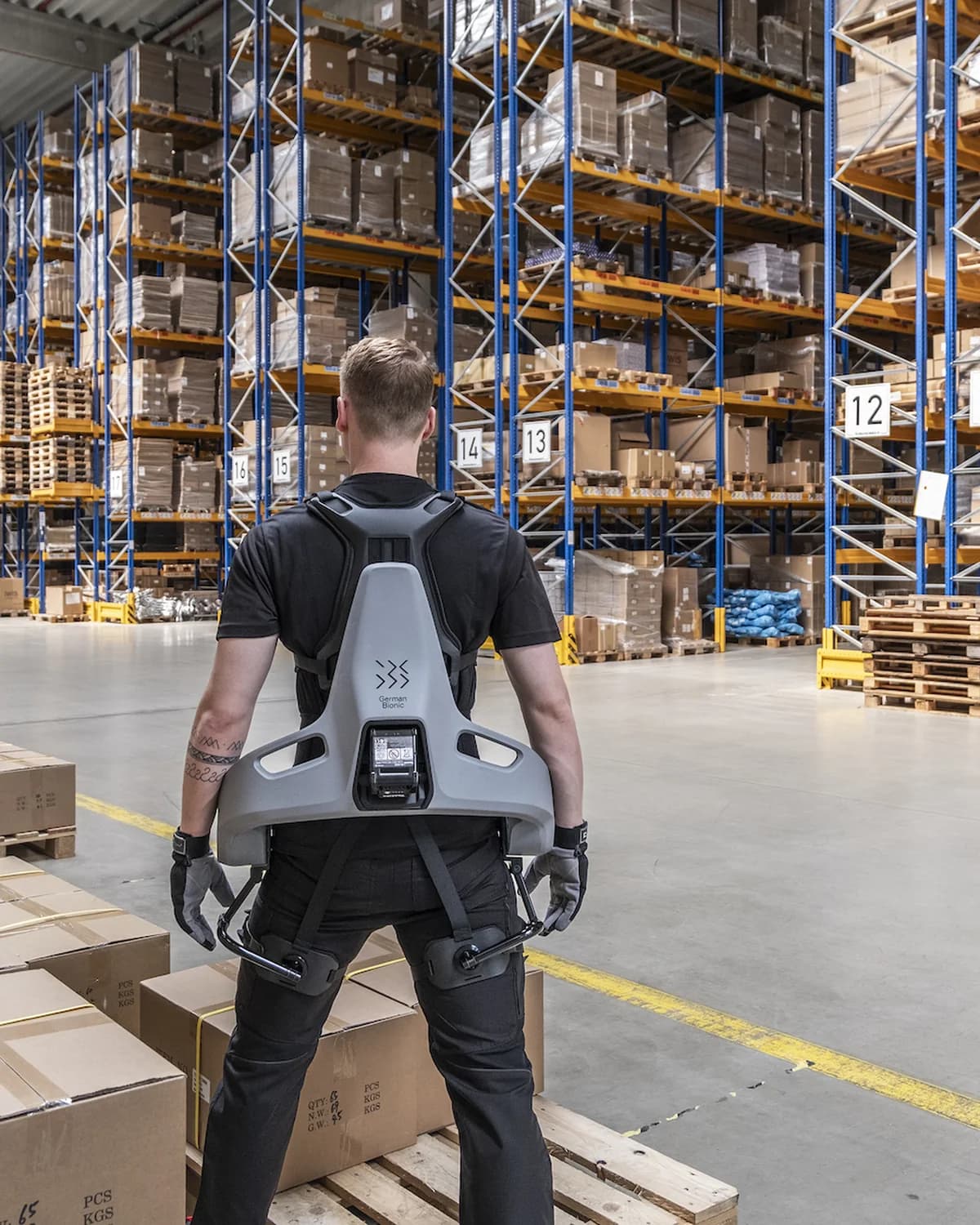
Quick answer: For industrial hip/back assist, the database supports two clear paths: the active German Bionic Cray X (powered back exoskeleton, 300 N assist, 8 h battery, from $9,900) for sustained lifting and forward bending, and the passive HeroWear Apex 2 (hip-assist exosuit, 220 N, 1.2 kg, from $1,195) for high-volume, low-cost deployment. Shoulder-focused systems like Skelex 360, MATE-XT and AIRFRAME are not hip/back assist devices and should be excluded from this comparison unless the task is overhead work.
The query “industrial exoskeleton comparison for hip / back assist” usually hides a simple procurement question: should we buy a powered back exoskeleton or a passive hip-assist exosuit? The database answers that with two directly comparable systems — Cray X and Apex 2 — plus three shoulder devices that are often mis-listed in the same category. This analysis isolates the hip/back decision, flags the parameters the datasheets do not disclose, and takes a stance on when each system is the wrong choice.
Key takeaways
- Only two systems in the database are explicitly hip/back assist: German Bionic Cray X (active, back) and HeroWear Apex 2 (passive, hip).
- Cray X lists 300 N assist force, 30 Nm torque, 30 kg lift support, 7.6 kg weight and 8 h battery; Apex 2 lists 220 N, 22 Nm, 20 kg, 1.2 kg and no battery.
- Price gap is large: Cray X from $9,900 vs Apex 2 from $1,195 (indicative list prices).
- Warranty is undisclosed for Cray X and MATE-XT, 12 months for Apex 2, 24 months for Skelex 360, unknown for AIRFRAME.
- Certification differs: Cray X lists CE and ISO 13482; Apex 2 lists CE only, with standards referenced unknown.
Comparison table: hip/back assist systems in the database
| System | Maker | Drive | Assist force | Assist torque | Lift support | Weight | Battery | Price from | Certifications |
|---|
| Cray X | German Bionic | Active | 300 N | 30 Nm | 30 kg | 7.6 kg | 8 h, hot-swappable | $9,900 | CE, ISO 13482 |
| Apex 2 | HeroWear | Passive | 220 N | 22 Nm | 20 kg | 1.2 kg | Not applicable | $1,195 | CE |
Shoulder systems excluded from the hip/back table: Skelex 360 (passive shoulder, 70 N, 1.6 kg, $4,900), MATE-XT (passive upper-limb, 100 N, 4.2 kg, $5,900), AIRFRAME (passive shoulder, 60 N, 1.5 kg, $2,950). They do not provide hip or back assist.
Why the active/passive split matters more than the spec sheet
Cray X is the only active system in this set. That means it carries a battery, sensors (IMU, load sensors, usage telemetry) and connectivity (Cray Visor app, cloud fleet dashboard, Bluetooth). Those features enable adaptive lift assistance and sit-to-stand support, but they also introduce charging logistics, firmware updates and data governance questions. Apex 2 has none of that: no sensors, no connectivity, no battery. It is a textile exosuit with elastic bands and task-selectable support. For a procurement team, the active/passive choice is a choice between a managed device fleet and a consumable-like PPE item.
Deployment constraints the database exposes
Height range is close but not identical: Cray X covers 160–195 cm, Apex 2 covers 150–200 cm. User weight limits are 110 kg for Cray X and 125 kg for Apex 2. Lead time is 6–10 weeks for Cray X and 2–4 weeks for Apex 2. Regional availability: Cray X lists Europe and North America; Apex 2 lists North America and Europe. Neither lists Asia-Pacific, while MATE-XT does — a relevant difference if you are standardising a global fleet.
Apex 2 offers sizes XS–XXL; Cray X offers two adjustable frame sizes. That sizing approach affects how many SKUs you stock and how quickly you can onboard a new worker.
Total cost of ownership: what the list prices hide
The indicative list prices are $9,900 for Cray X and $1,195 for Apex 2. Those are not total costs. Cray X requires battery management (8 h runtime, 2 h charge, hot-swappable lithium-ion), plus software and telemetry administration. Apex 2 has no battery, but its 12-month warranty and textile construction imply a different replacement cycle. The database does not disclose Cray X warranty, service contract pricing, spare battery cost or training cost. It also does not disclose Apex 2’s long-term durability or replacement band pricing. Any TCO model built on these two numbers alone is incomplete.
What the datasheet doesn't tell you
Warranty for Cray X is undisclosed. For a $9,900 powered device, warranty length and what it covers (battery, actuators, frame) are material to the business case. Without it, you cannot compare risk-adjusted cost against Apex 2’s 12 months.
Standards referenced for Apex 2 are unknown. Cray X lists ISO 13482 and EN 614-1. Apex 2 lists CE but the database marks standards as unknown. If your safety file requires a harmonised standard reference, that is an open item to request from HeroWear.
Clinical evidence is not applicable for Cray X and Apex 2 in this database. That is not a criticism; it means the evidence base for injury reduction is not captured here. Buyers should not assume clinical proof from a CE mark.
Max walking speed and stair/slope capability are not applicable for both systems. These are not mobility devices; do not specify them for tasks that require assisted walking or climbing.
Connectivity and data governance for Cray X are listed but not detailed. The database confirms Bluetooth, Cray Visor app and cloud fleet dashboard, but does not state data residency, retention or worker-consent features. For EU deployments, that is a works-council question, not an IT afterthought.
Who should not choose this
Do not choose Cray X if your lifting tasks are intermittent, your site cannot support battery charging and device tracking, or your budget cannot absorb a $9,900-per-unit list price plus undisclosed service costs. The active system’s value depends on sustained, repetitive lifting and forward bending; if your task mix is light and variable, the passive Apex 2 is the more defensible starting point.
Do not choose Apex 2 if you need documented ISO 13482 compliance in the safety file, or if your user population exceeds 125 kg or falls outside 150–200 cm. Also avoid it if you require telemetry for ergonomic programme reporting — it has no sensors or connectivity. And do not choose either system for overhead work: that is the domain of Skelex 360, MATE-XT or AIRFRAME, which are shoulder-assist devices.
Shoulder systems are not substitutes
Search results often mix hip/back and shoulder exoskeletons. The database is clear: Skelex 360, MATE-XT and AIRFRAME all list 0 DOF and lift support of 5 kg, with assist forces of 70 N, 100 N and 60 N respectively. They are designed for sustained arm elevation, not for hip extension or back support. Including them in a hip/back tender will distort the comparison and may confuse workers. Use the compare tool to keep categories separate.
Procurement recommendation
Start with the task, not the device. If the dominant exposure is repetitive lifting from floor to waist with a need for measurable assistance and fleet data, request a documented quote for Cray X, including warranty terms and battery service pricing. If the exposure is high-volume bending and lifting where cost per worker and ease of donning dominate, request an Apex 2 trial with a clear definition of textile durability and replacement intervals. For a mixed fleet, run both in separate cells and compare using the side-by-side comparison.
FAQ
Is Cray X a hip or back exoskeleton?
Cray X is a powered back exoskeleton for lifting, carrying and forward-bending tasks. It provides back assist, not hip assist.
Does Apex 2 have a battery?
No. Apex 2 is passive, with no battery, sensors or connectivity listed in the database.
Which system has ISO 13482 certification?
Cray X lists CE and ISO 13482. Apex 2 lists CE only; its standards referenced are unknown in the database.
For a documented parameter request or to discuss your task profile, contact the ExoSelect selection desk. For category context, see the industrial exoskeleton category.
 ExoSelect research