Quick answer
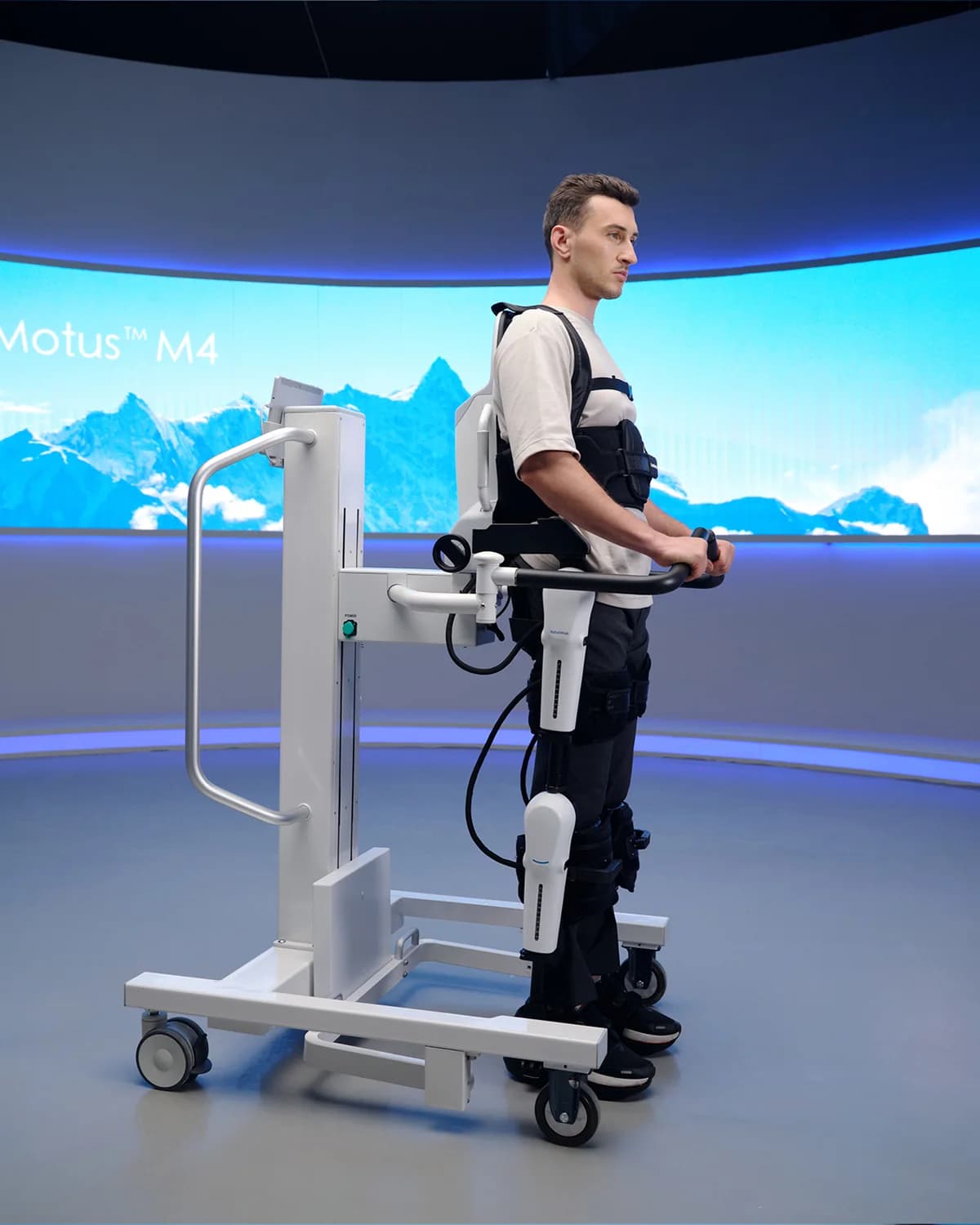
The ExoMotus M4 is a powered lower-limb exoskeleton from Fourier Intelligence for repeatable clinical gait training, with a 23.5 kg frame, 1.2 km/h top speed, 3 h battery life, and NMPA and CE certifications. It is best suited to rehabilitation clinics in Asia-Pacific, Europe, or the Middle East that need therapist-controlled assisted gait and can accept undisclosed pricing and assist-force data. Buyers requiring published torque figures or FDA clearance should look elsewhere.
Key takeaways
- Documented specs: 23.5 kg, 155–190 cm height range, 100 kg user weight, 1.2 km/h speed, 4 DOF, 3 h battery, 2 h charge, NMPA and CE marks.
- Peak assist force and peak assist torque are undisclosed or unknown—critical for comparing against EksoNR (40 Nm) or HAL (40 Nm).
- Price is undisclosed; regional distributor pricing means total cost of ownership depends on training and service quotes.
- Certifications cover NMPA and CE but not FDA, limiting North American deployment.
- Clinical evidence is described as “clinical rehabilitation studies in China,” with no named peer-reviewed journals in the dataset.
What the ExoMotus M4 is, and what the datasheet confirms
The ExoMotus M4 is an active, powered lower-limb exoskeleton made by Fourier Intelligence. Its stated purpose is repeatable clinical gait training. The datasheet confirms an aluminium alloy frame, adjustable sizing, four degrees of freedom, joint encoders and force sensors, and two control modes: therapist-controlled and assisted gait. Connectivity is limited to training data export. The system is available on inquiry through regional distributors, with a 12-month warranty and availability in Asia-Pacific, Europe, and the Middle East. For a full product page, see ExoMotus M4.
Two specifications stand out for procurement. First, the 23.5 kg weight is in line with the EksoNR (23.6 kg) but heavier than the Indego (12.3 kg) and HAL Lower Limb (17 kg). Second, the 1.2 km/h top speed is the slowest among the active systems in this dataset—EksoNR is 1.1 km/h, Indego 2 km/h, Atalante X 2.5 km/h, and HAL 1.5 km/h. For gait training, slower speeds may be appropriate for early-stage rehabilitation, but clinics targeting faster overground training should note the ceiling.
Specification comparison: ExoMotus M4 against documented alternatives
The table below uses only parameters present in the ExoSelect database. Cells marked “Not disclosed” or “Unknown” reflect missing data, not zero values.
| Parameter | ExoMotus M4 | EksoNR | Indego | HAL Lower Limb | Atalante X |
|---|
| Maker | Fourier Intelligence | Ekso Bionics | Parker Hannifin | Cyberdyne | Wandercraft |
| Drive | Active | Active | Active | Hybrid | Active |
| Weight | 23.5 kg | 23.6 kg | 12.3 kg | 17 kg | 65 kg |
| Height range | 155–190 cm | 152–193 cm | 155–195 cm | 145–190 cm | 145–190 cm |
| User weight | 100 kg | 100 kg | 113 kg | 100 kg | 100 kg |
| Speed | 1.2 km/h | 1.1 km/h | 2 km/h | 1.5 km/h | 2.5 km/h |
| Degrees of freedom | 4 | 4 | 4 | 2 | 12 |
| Peak assist torque | Unknown | 40 Nm | Unknown | 40 Nm | Unknown |
| Battery life | 3 h | 4 h | 4 h | 3 h | 4 h |
| Charge time | 2 h | 2.5 h | 2.5 h | 2 h | 3 h |
| Certifications | NMPA, CE | FDA, CE | FDA, CE | CE medical, ISO 13485 | CE medical |
| Regions | Asia-Pacific, Europe, Middle East | North America, Europe, Asia-Pacific | North America, Europe | Japan, Europe, Asia-Pacific | Europe, North America |
For a broader comparison across categories, see our comparison tool and the medical exoskeleton category.
What the datasheet doesn't tell you
Three missing parameters matter for procurement. First, peak assist force is undisclosed. Without it, a clinic cannot match the device to patient impairment levels or compare mechanical output against competitors. Second, peak assist torque is unknown. EksoNR and HAL both publish 40 Nm; the absence of a torque figure for the M4 makes it impossible to assess whether the system can support sit-to-stand or step initiation—functions EksoNR explicitly lists. Third, indicative price is undisclosed, and the price note states that training and service are quoted separately. That means the capital cost is only one line in a total-cost model that includes therapist training, maintenance contracts, and battery replacement. The datasheet also does not disclose rated lift support (not applicable for this device) or the specific clinical studies behind the “clinical rehabilitation studies in China” claim. Buyers should request the underlying study citations and a sample service contract before budgeting.
Deployment constraints and regional compliance
The M4 carries NMPA and CE marks and complies with IEC 60601-1. It does not carry FDA clearance in the supplied data. That is a hard stop for US clinical deployment unless a buyer pursues an investigational pathway. The regional availability list—Asia-Pacific, Europe, Middle East—reinforces that North America is not a primary market. Lead time is “contact regional distributor,” which introduces variability: a clinic in Germany and a clinic in Saudi Arabia may face different lead times and service-level agreements. The 12-month warranty is standard across this dataset, but the absence of an extended warranty option in the data means buyers should negotiate service coverage explicitly. For a deeper look at compliance, see our EksoNR product page for a comparison of FDA-cleared systems.
Who should not choose this
Do not choose the ExoMotus M4 if your procurement requires published peak assist torque or force figures. The database marks both as unknown or undisclosed, while EksoNR and HAL publish 40 Nm. If your clinical protocol depends on sit-to-stand or step initiation, the M4's control modes list only therapist-controlled and assisted gait—EksoNR explicitly lists sit-to-stand and step initiation. If you are deploying in North America, the lack of FDA clearance is disqualifying for most clinical uses. And if you need a fast overground training speed, the 1.2 km/h ceiling is the second-slowest in this dataset. The M4 is a reasonable candidate only for rehabilitation clinics in NMPA- or CE-accepting regions that prioritise therapist-controlled gait training and can tolerate data gaps during due diligence.
Total cost of ownership: what to ask before signing
Because price is undisclosed and training and service are quoted separately, the M4's total cost of ownership cannot be calculated from the datasheet alone. Ask the regional distributor for a five-year cost breakdown that includes: the capital purchase price, therapist training fees, annual service contract, battery replacement cost (the battery is swappable, but replacement price is not disclosed), and software update fees for the training data export function. Compare that package against the Indego, which has a lower weight and a 113 kg user weight limit, and the HAL Lower Limb, which is often offered as a lease or treatment programme rather than a capital purchase. For a structured comparison, use our compare page.
FAQ
What is the top speed of the ExoMotus M4?
1.2 km/h, according to the ExoSelect database.
Does the ExoMotus M4 have FDA clearance?
No. The database lists NMPA and CE certifications only; FDA is not disclosed.
What is the peak assist torque of the ExoMotus M4?
Unknown. The database marks peak assist torque as unknown and peak assist force as undisclosed.
Next step
Request a documented peak assist torque figure and a five-year service quote from your regional Fourier Intelligence distributor, then compare it side-by-side with the EksoNR using our comparison tool. If you need help interpreting the gaps, contact the ExoSelect selection desk.
 ExoSelect research