Quick answer: For neurorehabilitation, the five documented options are EksoNR (Ekso Bionics), HAL Lower Limb (Cyberdyne), Atalante X (Wandercraft), Indego (Ekso Bionics) and ExoMotus M4 (Fourier Intelligence). None has a disclosed price, peak assist force or peak assist torque, so selection must hinge on documented weight, speed, degrees of freedom, certifications and service model rather than on headline assistance claims.
If you are procuring a powered exoskeleton for stroke, spinal cord injury or neuromuscular gait training, the decision is not about which device looks most advanced. It is about which documented configuration fits your patient envelope, your therapy workflow and your regulatory jurisdiction. The database shows five clinical systems with completeness scores between 88 and 92, but every one of them leaves the same three commercial parameters undisclosed: price, peak assist force and, for four of the five, peak assist torque.
Key takeaways
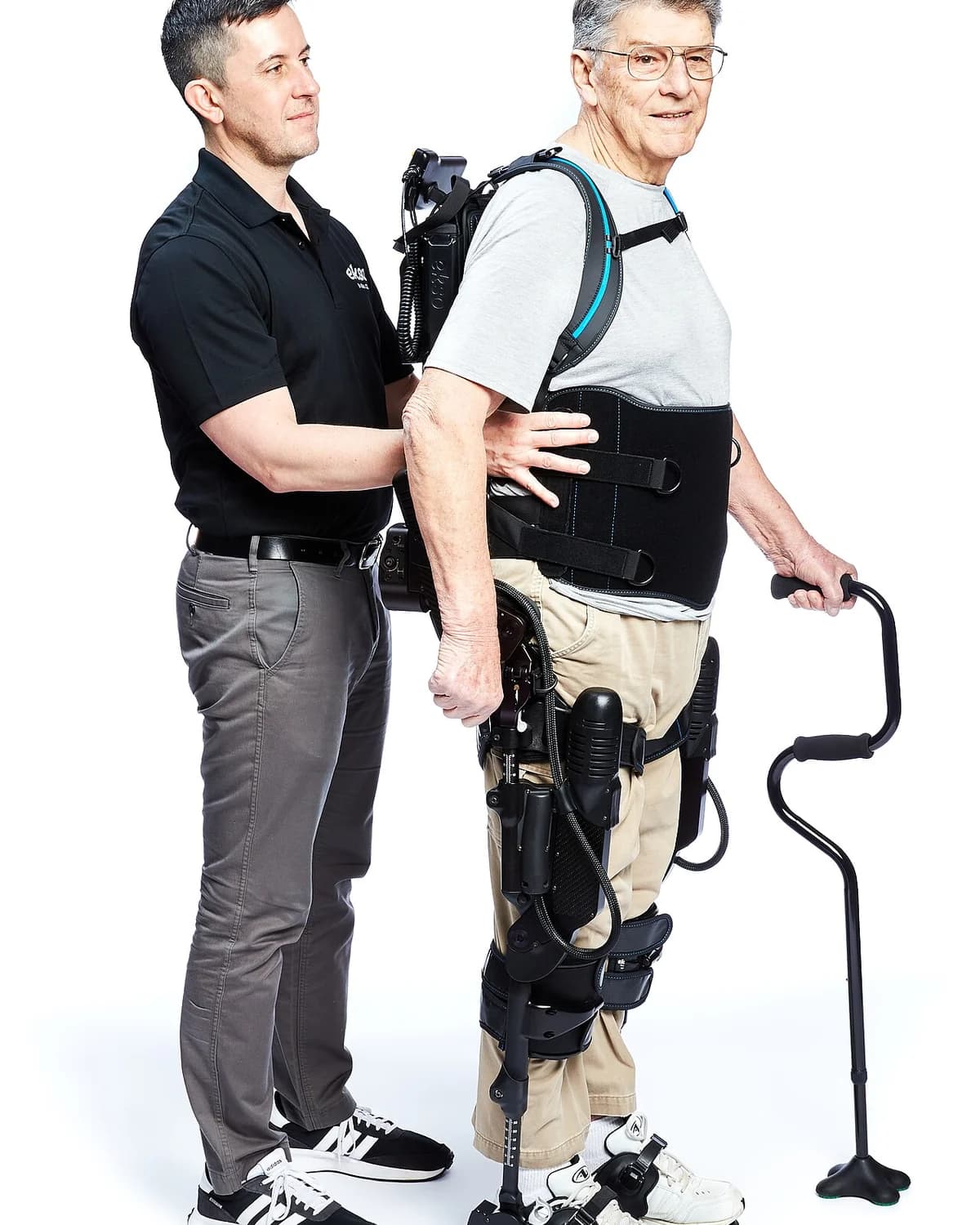
- EksoNR and Indego are both from Ekso Bionics; the Indego line was acquired from Parker Hannifin in 2022 and is now sold and serviced by Ekso Bionics.
- Atalante X is the only system in this set with a disclosed lift support of 80 kg and 12 degrees of freedom.
- HAL Lower Limb is the lightest at 17 kg and the fastest at 1.5 km/h, but it is often offered as a treatment or lease programme rather than a capital purchase.
- ExoMotus M4 carries NMPA and CE certification, which matters for buyers in Asia-Pacific and the Middle East.
- No system in this dataset discloses an indicative price or peak assist force.
Comparison table: documented specifications only
| System | Maker | Weight | Speed | Degrees of freedom | Lift support | Certifications | Availability |
|---|
| EksoNR | Ekso Bionics | 23.6 kg | 1.1 km/h | 4 | Not applicable | FDA, CE | Available on inquiry |
| HAL Lower Limb | Cyberdyne | 17 kg | 1.5 km/h | 2 | Not applicable | CE medical, ISO 13485 | Lease or treatment programme |
| Atalante X | Wandercraft | 65 kg | 2.5 km/h | 12 | 80 kg | CE medical | Available on inquiry |
| Indego | Ekso Bionics | 12.3 kg | 2 km/h | 4 | Not applicable | FDA, CE | Available on inquiry |
| ExoMotus M4 | Fourier Intelligence | 23.5 kg | 1.2 km/h | 4 | Not applicable | NMPA, CE | Available on inquiry |
All five systems are active or hybrid drive and are intended for therapist-supervised clinical use. The table deliberately omits price, peak assist force and peak assist torque because the database records these as undisclosed or unknown for every system. Any vendor proposal that leads with those numbers is supplying data outside this independent dataset.
What the datasheet doesn't tell you
Peak assist force is undisclosed for all five systems. This is the single most important missing parameter for neurorehabilitation procurement because it determines whether a device can support a patient with severe weakness versus one with partial volitional movement. Without it, you cannot compare the therapeutic intensity of EksoNR against HAL Lower Limb or ExoMotus M4 on a like-for-like basis. Ask each maker for a documented peak assist force in newtons at the hip and knee, and treat verbal claims as unverified.
Peak assist torque is unknown for Atalante X, Indego and ExoMotus M4, and undisclosed for EksoNR and HAL Lower Limb. EksoNR and HAL Lower Limb both list 40 Nm in the database, but the unknown state for the other three means you cannot build a torque-normalised comparison across the set. For a rehabilitation buyer, torque at the joint is a better proxy for gait-assist capability than overall weight, so this gap directly affects which patients each system can serve.
Indicative price is undisclosed for every system. The database records price notes only: EksoNR, Atalante X and Indego are quoted by the maker or regional distributor; HAL Lower Limb is often offered as a treatment or lease programme; ExoMotus M4 uses regional distributor pricing with training and service quoted separately. That means total cost of ownership cannot be modelled from public data. You must request a written five-year cost schedule that separates capital, training, service, battery replacement and software licensing.
Battery and charge data are documented but not directly comparable. EksoNR and Indego both list 4 h battery life with 2.5 h charge time; HAL Lower Limb lists 3 h and 2 h; Atalante X lists 4 h and 3 h; ExoMotus M4 lists 3 h and 2 h. All are swappable. In a busy gait-training gym, the charge-to-use ratio matters more than raw battery life, and only a workflow trial will show whether one battery per device is enough for your session schedule.
Deployment constraints the brochure skips
Atalante X weighs 65 kg. That is more than five times the weight of Indego at 12.3 kg. The self-balancing architecture and 80 kg lift support explain part of that mass, but it also means floor loading, storage space and therapist handling are different procurement categories. If your clinic has older floors or shared gym space, request a floor-loading assessment before shortlisting Atalante X.
HAL Lower Limb is the only system in this set with a 2-degree-of-freedom configuration and a 2.5 km/h top speed, the fastest documented. Cyberdyne's official product page describes bioelectric signal control, which requires a patient with detectable muscle activity. That is a clinical inclusion criterion, not a specification, and it should be written into your patient-selection protocol.
EksoNR and Indego both carry FDA and CE certification and are available in North America and Europe. ExoMotus M4 carries NMPA and CE and is listed for Asia-Pacific, Europe and the Middle East. Atalante X is CE medical only and listed for Europe and North America. If you are buying in the United States, Atalante X's FDA status is not recorded in this dataset, so confirm it directly with Wandercraft before contracting.
Who should not choose this
Do not choose Atalante X if your rehabilitation gym cannot accommodate a 65 kg device or if your procurement requires FDA clearance that is not documented here. The self-balancing design is a genuine clinical differentiator for overground gait training, but the mass and the missing FDA record make it a poor first purchase for a small outpatient clinic.
Do not choose HAL Lower Limb if you need a capital purchase with a fixed asset on your balance sheet. The database records its availability as a lease or treatment programme, and Cyberdyne's own product page frames it as a medical treatment device. If your finance team requires depreciation of owned equipment, HAL is the wrong commercial model regardless of its clinical merits.
Do not choose EksoNR or ExoMotus M4 if your primary need is personal mobility outside the clinic. Both are described as therapist-supervised or therapist-controlled gait-training systems. Indego is the only system in this set explicitly described as serving both clinical gait training and personal mobility, which makes it the more defensible choice for a mixed-use rehabilitation and community programme.
Procurement checklist for neurorehabilitation buyers
Request a documented peak assist force and peak assist torque for every shortlisted system. Neither is available in this dataset, and no vendor should be allowed to substitute a marketing range for a measured value. Ask for the test standard and the joint at which the figure was measured.
Request a five-year cost schedule that separates capital, therapist training, service contract, battery replacement and software licensing. The database records 12-month warranties for all five systems, so years two through five are entirely a service-contract question. Compare those schedules side by side using the ExoSelect compare tool.
Confirm the regulatory status in your jurisdiction. EksoNR and Indego list FDA and CE; HAL Lower Limb lists CE medical and ISO 13485; Atalante X lists CE medical; ExoMotus M4 lists NMPA and CE. A CE mark alone does not authorise clinical use in every country, and the database does not record local reimbursement status for any system.
Where ExoSelect adds value
This guide is built from the ExoSelect medical exoskeleton database, which records completeness scores of 92 for EksoNR and HAL Lower Limb, 88 for Atalante X, Indego and ExoMotus M4. The scores reflect how many documented parameters each maker publishes, not clinical quality. A higher score means fewer unknowns, which is a procurement advantage in itself. Browse the full medical exoskeleton category to see how these five systems sit alongside other clinical devices.
For a documented parameter request or a shortlist review, contact the ExoSelect selection desk. We do not sell exoskeletons and we do not accept vendor-sponsored placements in comparison tables.
FAQ
Which neurorehabilitation exoskeleton has the highest documented lift support?
Atalante X, at 80 kg. The other four systems record lift support as not applicable, which means the parameter is not part of their documented specification rather than that they cannot support a patient.
Is HAL Lower Limb available to buy outright?
The database records its availability as a lease or treatment programme, and Cyberdyne's official product page describes it as a medical treatment device. Capital purchase terms are not disclosed.
Which system is best for a clinic that needs both gait training and personal mobility?
Indego is the only system in this dataset explicitly described as serving both clinical gait training and personal mobility. It is also the lightest at 12.3 kg, which matters for transport and storage.
Next step
Request the documented peak assist force and peak assist torque for EksoNR and Indego from Ekso Bionics, then compare both against Atalante X using the ExoSelect comparison tool. If the maker cannot supply a measured value at the hip and knee, treat the system as unverified for severe-weakness patient cohorts.
 ExoSelect research